
If your main need is capturing leads and booking appointments, an answering service (or an AI-driven answering platform) is usually the right call. Save the call center for high-volume operations where most calls require system access and full resolution, not just a message or a scheduled visit.
Picture two businesses. A small HVAC contractor gets after-hours calls from homeowners with no heat at 9 p.m. They need someone (or something) to answer instantly, capture the job details, and get it on the schedule. That is an answering service problem. Now picture an e-commerce brand fielding thousands of monthly calls about returns, refunds, and order status, each requiring access to order history and payment systems. That is a call center problem.
- Answering service: best for lead capture, scheduling, and message-taking at moderate call volumes.
- Call center: best for high-volume, multi-step resolution that needs CRM or order-system access.
- LeadGuard™: built specifically for HVAC contractors who need instant, 24/7 lead qualification and booking without hiring a call center.
Key Takeaways
Matching call volume and complexity to the right model, answering service for lead capture and scheduling, call center for high-volume system-dependent resolution, determines both cost and customer experience.
| Point | Details |
|---|---|
| Match model to complexity | Choose based on whether calls need system access, not just raw call volume. |
| Answering services cost less | Small-business plans typically run $50 to $300 monthly versus per-agent-hour call-center rates. |
| Call centers take longer to launch | Integration and training usually stretch onboarding to weeks or months versus days. |
| Pilot before committing | Test a limited call segment before rolling out either model fully. |
| LeadGuard™ fits HVAC lead capture | Its Starter, Professional Growth, and Enterprise HVAC plans target instant answering and booking for HVAC contractors specifically. |
Table of Contents
- Answering Service vs Call Center: What an Answering Service Actually Does
- What Is a Call Center and How Does It Differ?
- Key Differences at a Glance
- How Do You Choose Between the Two?
- Answering Service vs Call Center Costs: What to Budget For
- What Happens When You Go Live
- LeadGuard™: Built for HVAC Call Handling, Not Generic Support
- Why Most SMBs Overthink This Decision
- Get Started With LeadGuard™
- Frequently Asked Questions
- Sources
Answering Service vs Call Center: What an Answering Service Actually Does
An answering service is a virtual reception layer. Agents (often shared across multiple client accounts) work from scripts you provide, answering calls under your business name and handling a defined set of tasks. They are not embedded in your operations. They are a front door that never closes.
Here is what that typically looks like in practice:
- Message-taking. Callers get a live person, their information gets logged, and you get a summary by text or email.
- Appointment scheduling. Agents check your calendar rules and book slots directly, often through a shared scheduling tool.
- Basic FAQs. Hours, service areas, pricing ranges, and other static information get answered without escalation.
- Escalation per protocol. Anything outside the script gets flagged or transferred based on rules you set in advance.
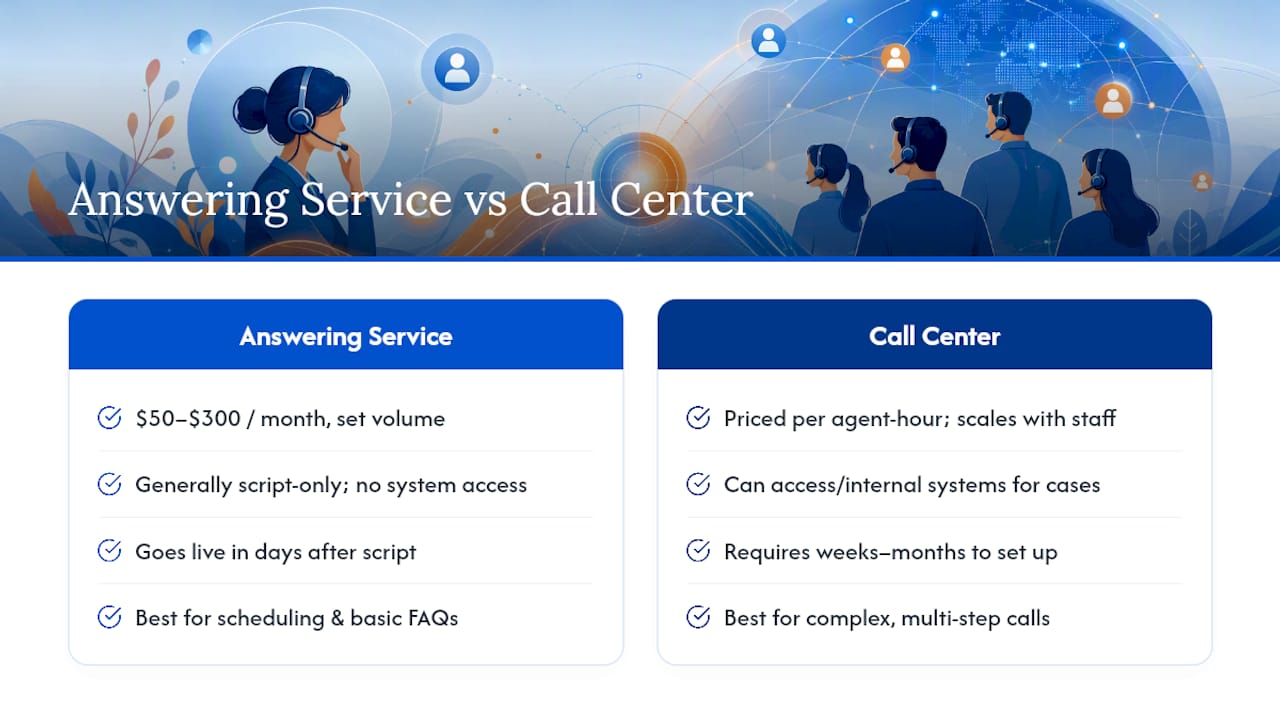
The economics make sense for small and mid-size operations. Because agents are shared across many client accounts rather than dedicated to yours, pricing tends to run in flat monthly tiers or modest per-call rates rather than hourly staffing costs. Small-business answering-service packages commonly fall in the $50 to $300 per month range, according to industry pricing comparisons, a fraction of what dedicated staffing costs.
The limits show up fast once your business gets more complex. Shared agents typically cannot log into your CRM, dispatch software, or order-management system. They cannot process a refund, adjust an invoice, or troubleshoot an account issue that requires pulling up records. They can capture a lead and get it on your calendar. They cannot resolve a dispute. For HVAC companies specifically, answering services deliver clear returns precisely because most incoming calls are simple: someone needs service, and someone needs to book it.
What Is a Call Center and How Does It Differ?
A call center (or contact center) is built around dedicated or account-assigned agents who have real access to your systems and are trained to resolve problems end to end, not just log them. This is the operational difference that matters most: an answering service takes a message, a call center closes the loop.
Call centers typically offer:
- CRM and order-system access, so agents can look up account history, process returns, or update records in real time.
- Multi-channel support, blending phone, chat, and email into one queue.
- Outbound campaigns, for renewals, win-backs, or scheduled follow-ups.
- Dedicated or pooled specialist teams, trained specifically on your product, policies, and escalation paths.
That depth costs more, and the pricing structure reflects it. Instead of a flat monthly package, call centers are typically quoted on a per-agent-hour basis. Wages for customer service representatives run high enough that Bureau of Labor Statistics data on the occupation is often cited when estimating the fully loaded cost of dedicated staffing, benefits, training, and management layered on top of base pay. A shared answering-service agent handling a two-minute call for you and nine other clients simultaneously costs far less per interaction than a dedicated agent trained solely on your account.
Onboarding reflects that complexity too. Where an answering service can go live in days once you approve a script, a call center engagement usually takes weeks to months. Vendors need time to build system integrations, train agents on your specific products and policies, and set up quality assurance workflows. Enterprise call-center providers commonly cite service-level agreements, workforce management systems, and structured QA programs as core parts of their offering, and each of those takes real setup time before a single live call gets handled.
Contract terms tend to run longer too. Where answering services often work month-to-month, call-center contracts frequently include minimum terms, volume commitments, or ramp-up fees tied to the integration work required to get agents operating inside your systems.
Key Differences at a Glance
The choice usually comes down to six factors, and getting even one wrong can mean overpaying or under-serving your callers.
- Staffing model. Shared agents (answering service) handle multiple clients and follow scripts; dedicated agents (call center) train specifically on your account and systems.
- Resolution depth. Answering services log and route; call centers resolve, adjust, and close. First-call resolution matters far more once your calls involve account changes or troubleshooting.
- Volume and handle time. Answering services fit lower, simpler volumes well. Call centers scale for high volume, but handle times run longer per call because agents do more per interaction.
- System access. This is the real dividing line. If agents need to touch your CRM, dispatch platform, or order system, you need call-center-level integration, not a script.
- Pricing shape. Answering services quote flat monthly fees or per-call rates. Call centers quote per-agent-hour, which scales with headcount and hours covered.
- Speed to launch. Days for an answering service, weeks to months for a call center, largely driven by integration and training requirements.
According to one industry comparison of the key differences between answering services and call centers, quality assurance is another differentiator worth watching: call centers typically run mature QA programs with regular call scoring, while answering services usually offer basic call recordings and spot checks.
Pro Tip: Don’t size your decision by call volume alone. A business fielding 500 simple scheduling calls a month still fits an answering service. A business fielding 100 calls that each require account lookups needs a call center.
How Do You Choose Between the Two?
Start by measuring, not guessing. Here is the process that actually produces a defensible decision:
- Track your calls for two to four weeks. Log volume, average length, and outcome category: lead, scheduling, or resolution requiring system access.
- Sort by system dependency. Ask what percentage of calls need someone to look something up versus follow a script. If most calls can be handled with a script and a calendar, you don’t need a call center.
- Run the budget math. Compare a flat monthly answering-service plan against the estimated hourly run rate of dedicated call-center staffing across your expected call hours.
- Weigh your timeline. If you need coverage this week, an answering service or AI answering platform launches far faster than a call-center integration project.
- Pilot before committing. Test either option on a subset of your call traffic (say, after-hours calls only) before rolling it out across your whole line.
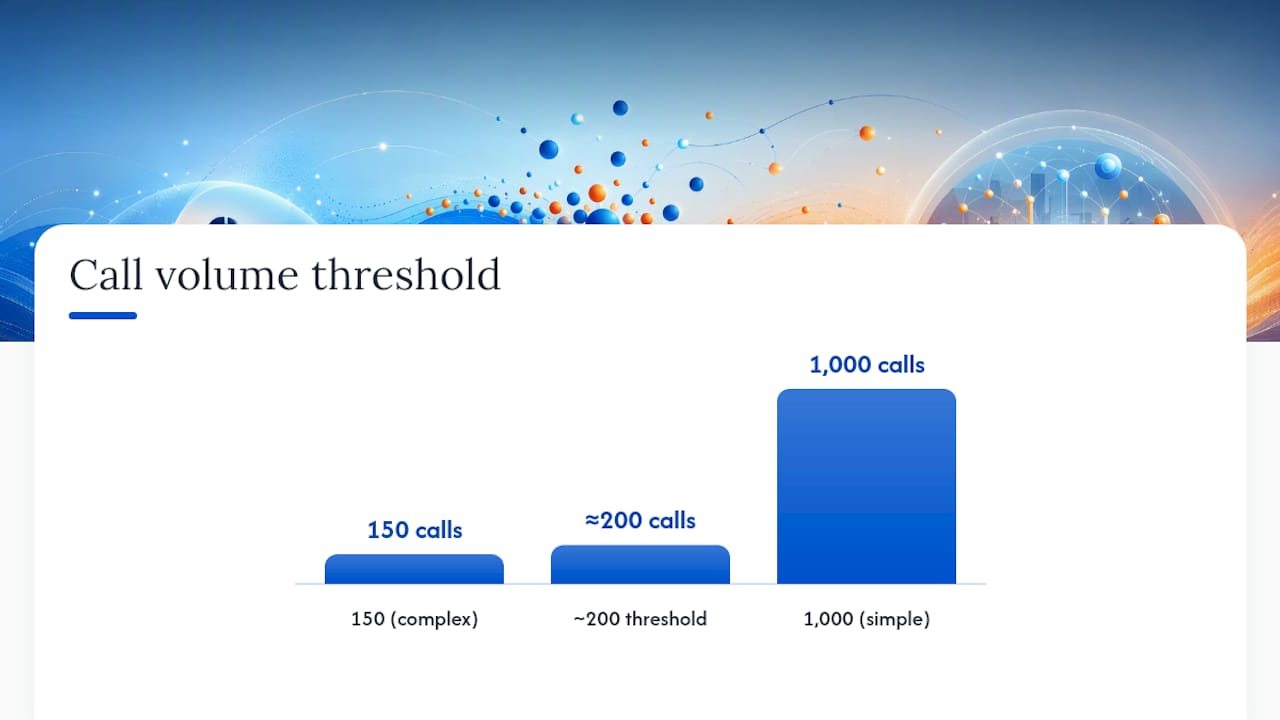
Industry commentary consistently points to one overlooked factor: complexity, not raw volume, should drive the decision. A business with 1,000 monthly calls that are all simple bookings is still a strong answering-service fit. A business with 150 monthly calls that each require pulling account records probably needs call-center-level access.
Here’s a rule of thumb you can apply today: if you’re under roughly 200 calls a month and most of them are about scheduling or basic questions, an answering service fits. If your volume is high or most calls require resolving something in a system, lean toward a call center.
Answering Service vs Call Center Costs: What to Budget For
Cost is where the two models diverge sharply, and the gap is bigger than most owners expect going in.
Small-business answering-service plans commonly run $50 to $300 per month for a defined call volume, with overage fees beyond that cap. Call centers, by contrast, are usually quoted per agent hour, and once you factor in wages referenced in BLS occupational data plus training, benefits, and management overhead, covering just one shift of dedicated phone coverage can cost several times an answering-service plan’s entire monthly fee.
Here’s how the two models typically stack up for a business covering after-hours calls:
| Cost Factor | Answering Service | Call Center |
|---|---|---|
| Pricing shape | Flat monthly fee or per-call rate | Per-agent-hour rate |
| Typical monthly range | $50 to $300 for defined volume | Scales with hours and headcount |
| Hidden costs | Overage fees past plan limits | Integration, training, and QA setup fees |
| Contract minimums | Usually month-to-month | Often multi-month with volume commitments |
Hidden costs deserve attention on both sides. Answering services can tack on overage charges once you exceed your plan’s call cap. Call centers often carry setup fees for system integration, agent training time, and ongoing QA staffing that never show up in the headline hourly rate. AI-powered answering platforms are reshaping this math by offering fixed monthly pricing at high call capacity, which changes the old assumption that more volume always means more cost.
What Happens When You Go Live
Answering-service onboarding is fast because the workload is light on integration. You provide a script, define escalation rules, and approve a call flow, and most vendors can have you live within days.
Call-center onboarding takes longer because there’s more to build:
- System integrations connecting agents to your CRM, dispatch, or order platform.
- Agent training on your specific products, policies, and tone.
- Contract terms covering minimum volume, SLAs, and ramp-up periods, often spanning weeks to months before full launch.
- Ongoing governance, including reporting cadence and call monitoring against defined quality benchmarks.
Whichever model you consider, ask about data handling before signing anything. Harvard Business Review’s research on customer data transparency makes the case that trust hinges on how clearly a vendor explains what it collects and why, a standard worth applying to any provider that will touch your callers’ information. Start with a limited pilot, one line or one shift, before committing to a full rollout.
LeadGuard™: Built for HVAC Call Handling, Not Generic Support
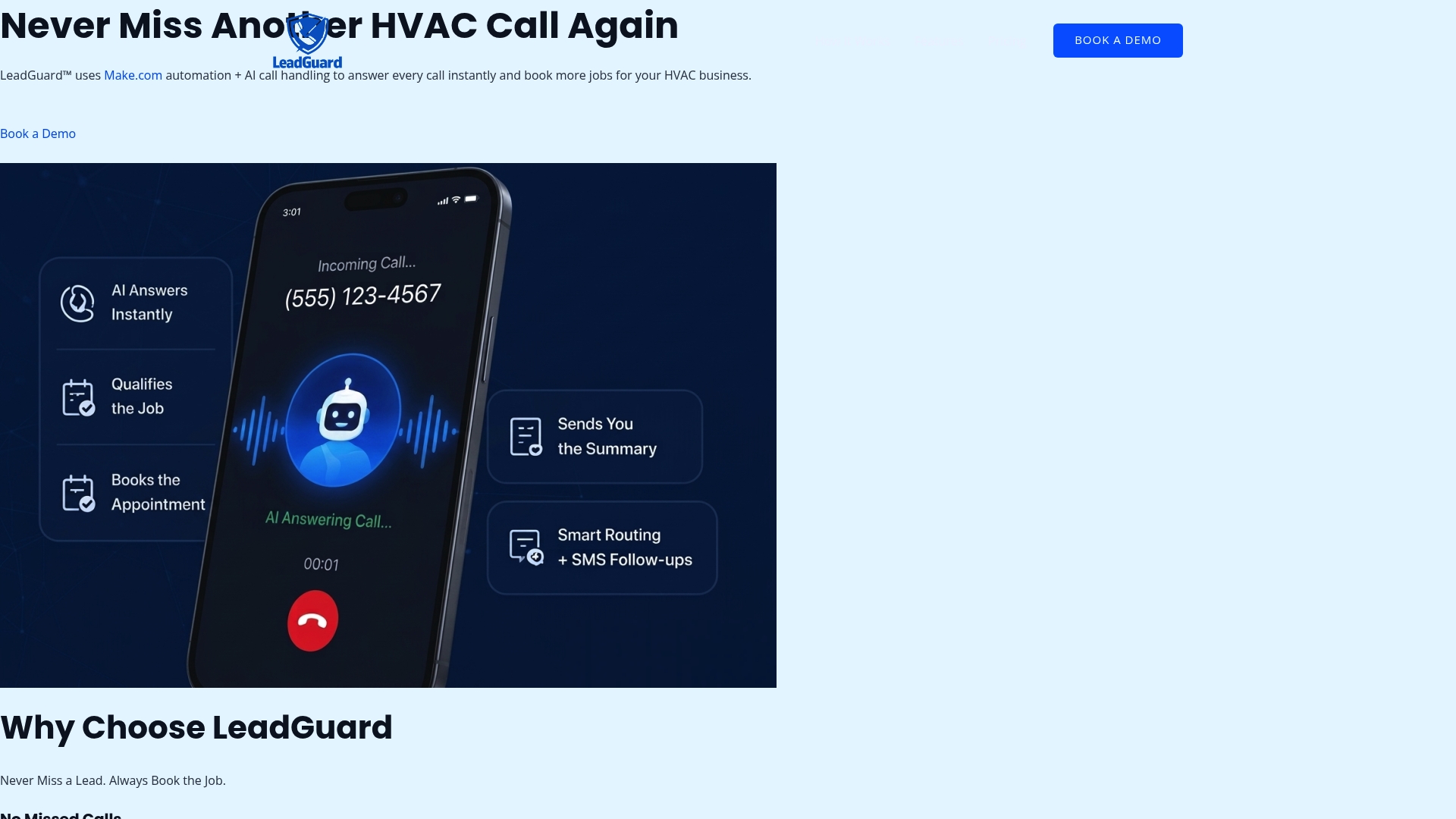
LeadGuard™ was built around the exact gap this comparison exposes: HVAC contractors don’t need a call center’s overhead, but they do need more than a basic message-taking service. The platform answers every call instantly, day or night, with no voicemail, then qualifies each lead by collecting job details and booking the appointment automatically.
Capabilities that matter for this decision:
- 24/7 instant answering with zero missed calls, even during peak season surges.
- AI-driven lead qualification that gathers the details your team needs before dispatch.
- Automated appointment scheduling tied directly into your calendar.
- SMS consent verification, keeping outreach compliant with messaging rules.
Depending on business size, LeadGuard™ offers the Starter HVAC Plan for smaller contractors, the Professional Growth HVAC Plan for growing teams needing more automation, and the Enterprise HVAC Plan for multi-location operations needing advanced workflows.
Pro Tip: When you pilot LeadGuard™, track three numbers from day one: lead capture rate, booked appointments, and lead-to-job conversion. Those three tell you everything about fit within the first month.
Why Most SMBs Overthink This Decision
The conventional advice treats this as a binary: pick the cheaper option or pick the more capable one. That framing misses the actual variable that predicts satisfaction, which is whether your calls are transactional or investigative. A homeowner calling for a furnace repair wants a fast response and a booked slot. That’s a transaction. An e-commerce customer disputing a charge wants someone who can pull their order and fix it. That’s an investigation.
What gets underestimated is how much revenue leaks through the transactional gap. Service businesses lose jobs not because they lack capability, but because the phone rang twice and went to voicemail. A call center is overkill for that problem, and a human answering service, while better, still can’t book a job the moment it hangs up. That gap between “someone answered” and “the job got booked” is where most SMBs lose money without noticing.
Prioritize speed and booking completion over raw resolution depth if your business runs on service calls, not disputes. That’s a smaller problem than most owners assume, and it has a smaller, faster solution than a call center.
Get Started With LeadGuard™
LeadGuard™ is the answering solution built specifically for HVAC contractors caught in the gap this article just described: too much call volume for voicemail, too little complexity to justify a call center’s cost and training timeline. Every call gets answered instantly, qualified automatically, and booked directly into your schedule, with no agents to hire and no scripts to maintain manually.
If you’re running a smaller shop, the Starter HVAC Plan gets you 24/7 coverage without the overhead of a full staffing solution. Growing operations fielding more calls fit better with the Professional Growth HVAC Plan, which adds deeper automation and workflow customization. Multi-location contractors should look at the Enterprise HVAC Plan for centralized call management and advanced integrations across teams.
Check pricing and features on the LeadGuard™ shop to find the plan that matches your current call volume, and book a walkthrough to see how fast you can get live.
Frequently Asked Questions
Is an answering service cheaper than a call center?
Yes, usually by a wide margin. Small-business answering-service plans typically run $50 to $300 per month for a set call volume, while call centers are priced per agent hour, which scales quickly with staffing needs.
Can an answering service access my CRM or scheduling system?
Standard answering services generally work from scripts and don’t log into your internal systems. AI-driven platforms built for a specific industry, like LeadGuard™ for HVAC, are the exception, integrating directly with scheduling to book appointments automatically.
How long does it take to set up each option?
An answering service or AI answering platform can typically go live within days once you approve a call script. A call center usually needs weeks to months for training and system integration.
What call volume justifies a call center?
There’s no fixed number, but volume matters less than complexity. If most of your calls require pulling account records, processing transactions, or multi-step troubleshooting, a call center fits even at moderate volume. If most calls are about scheduling or basic questions, an answering service works even at high volume.
Does LeadGuard™ replace a call center for HVAC businesses?
For most HVAC contractors, yes. Since the core need is instant call answering, lead qualification, and appointment booking rather than complex account resolution, LeadGuard™’s services are built to cover that exact use case without call-center overhead.
Sources
- Customer service representatives: Occupational Outlook Handbook | Bureau of Labor Statistics
- Customer Data: Designing for Transparency and Trust | Harvard Business Review
- Answering Service vs Call Center: Which Is Right for You? | Vida AI Agent OS
- Answering service vs call center: key differences explained – Shulex VOC Blog