
Round robin call routing cycles inbound calls through your agent group in a fixed rotation, so each agent takes a turn before the sequence repeats. It’s the right choice when your agents have similar skills and every lead carries roughly equal value. It’s the wrong choice when calls need to reach a specific expert.
Picture a five-person sales team fielding new installation quotes. Round robin sends call one to Agent A, call two to Agent B, and so on, looping back to A once everyone’s had a turn. A generic support queue works the same way: no single technician gets buried while others sit idle. For HVAC contractors specifically, Leadguard answers every call the instant it rings, then routes or qualifies it before a homeowner ever hits voicemail.
- Sales teams selling comparable-value leads
- Support queues where any qualified rep can help
- Any setup where “who’s next” matters more than “who’s best”
Quick fact: vendor documentation consistently frames round robin as the default fairness mechanism in automatic call distributor systems, precisely because it requires no skill mapping to work.
Key Takeaways
Round robin call routing works best as an even-distribution baseline for teams with comparable skills, tuned with a 10 to 20 second timeout and a solid overflow path.
| Point | Details |
|---|---|
| Best fit | Choose round robin when agents share similar skills and leads carry equal value. |
| Timeout default | Start ring timeout at 10 to 20 seconds, then adjust based on abandonment rate. |
| Watch for mismatch | Round robin balances call count, not talk time or complexity, so monitor for overload. |
| Build in overflow | Configure a secondary queue or fallback so simultaneous spikes don’t stack unanswered. |
| Leadguard’s role | Leadguard automates instant answer, qualification, and overflow for HVAC teams across three plan tiers. |
For deeper technical reference, see Exotel’s round robin documentation, Salesforce’s intelligent routing overview, and JustCall’s setup walkthrough.
Table of Contents
- How Does Round Robin Call Routing Work?
- What Are the Benefits of Round Robin Routing?
- When Should You Use Round Robin vs. Other Routing Models?
- What Are the Limitations of Round Robin Call Routing?
- How Do You Set Up a Round Robin Call Queue?
- What Ring Timeout and Overflow Settings Work Best?
- How Does Leadguard Apply Round Robin for HVAC Businesses?
- What Security and Privacy Considerations Apply to Call Routing?
- Which Leadguard Plan Fits Your HVAC Business?
- Frequently Asked Questions About Round Robin Call Routing
- Sources
How Does Round Robin Call Routing Work?
The system tracks a rotation position, not just a list of agents. When call one lands, it goes to whoever is next in line. That position advances regardless of outcome. If Agent B is on another line or logged out, most systems skip them and move to Agent C, but a well-built rotation remembers that B was owed a turn and gives it back on the next cycle. Thinkpickle’s breakdown of this bookkeeping detail is worth reading if you want to understand why some round robin setups feel unfair even when they’re technically working.
Timeouts control how long the system waits before skipping. Setting an appropriate timeout helps balance caller wait times with agent availability.
Round robin isn’t the only distribution model. Here’s how it stacks up against common alternatives:
| Method | How it decides the next agent |
|---|---|
| Round robin (circular) | Fixed rotation order, cycles regardless of call history |
| Uniform | Balances total calls received over time, not strict order |
| Longest idle | Routes to whoever has waited longest since their last call |
| Simultaneous | Rings multiple agents at once, first to answer wins |
| Weighted | Skews distribution toward specific agents by ratio |
Exotel’s documentation describes round robin specifically as a sequential, cyclical distribution model designed around fairness rather than skill matching. That distinction drives everything else in this guide.
What Are the Benefits of Round Robin Routing?
Fair distribution isn’t just a nicety. It changes how your team performs and how you measure them.
- Equal opportunity, equal morale. No agent watches a colleague rack up commissions while their own queue stays empty.
- Clean performance baselines. When every rep gets a comparable volume of comparable leads, you can actually compare close rates without arguing about lead quality.
- Predictability. Agents know roughly when their next call is coming, which makes shift planning and break scheduling simpler.
- Lower burnout risk. Brightcall’s explainer points to reduced single-agent overload as one of round robin’s core practical benefits, especially on teams where a few agents tend to absorb the bulk of inbound volume.
An HVAC office running four dispatchers on round robin, for example, sees a much flatter call count per person than a first-come system where the fastest phone-grabber wins every time. That evenness is the whole point.
When Should You Use Round Robin vs. Other Routing Models?
Round robin fits some teams perfectly and fails others outright. Match the model to your actual team structure before you flip the switch.
- Use round robin for small-to-mid sales or support teams where agents share comparable skills and every inbound call is worth roughly the same to your business.
- Skip round robin for skill-differentiated teams. If one tech handles heat pumps and another handles ductless systems, cyclic routing sends the wrong caller to the wrong specialist.
- Avoid round robin for dedicated account relationships. Repeat customers who expect “their” rep need a different model entirely.
- Combine models when your team is mixed. Run round robin inside a skill tag or a schedule block. Salesforce’s intelligent routing framework shows how CRM data and round robin logic can coexist rather than compete.
What Are the Limitations of Round Robin Call Routing?
Round robin balances call count, not call duration or complexity. An agent who lands three quick reschedule calls looks “equal” to one who spent 40 minutes talking someone through an emergency furnace failure, even though their actual workload was nowhere close.
- Timezone and shift mismatches cause unfair skips if schedules aren’t configured
- Skill mismatches drive up transfer rates when the rotation ignores expertise
- Simultaneous call spikes need an overflow path, or excess volume just stacks up in queue
- Pure round robin, without CRM context, can miss the fact that a caller has an open ticket already
Pro Tip: Pair round robin with a simple skill tag for your two or three highest-complexity call types, and let round robin handle everything else. You get fairness without sacrificing expertise where it actually matters.
How Do You Set Up a Round Robin Call Queue?
Most phone systems follow a similar setup pattern, whether you’re configuring a contact center platform or a smaller VoIP tool. JustCall’s help documentation lays out a typical flow: pick a number, assign team members, select round robin as the ringing order, add users, and save.
Here’s the fuller checklist:
- Define your queue scope. Decide which number, department, or campaign feeds this rotation, and finalize your agent roster.
- Set schedules and presence flags. Mark who’s on shift, who’s on break, and who’s logged out entirely, so the system skips accurately.
- Choose your ring timeout. Start at 10 to 20 seconds. That range balances caller patience against giving the intended agent a real chance to pick up.
- Set skip policy. Decide whether an unanswered call skips immediately or holds briefly first, and confirm skipped agents keep their place in rotation.
- Configure overflow targets. Build a secondary queue, voicemail-to-text, or callback option for when every agent is busy at once.
- Handle after-hours routing. Route calls outside business hours to a night queue, an answering service, or an automated capture tool.
- Run test calls. Call the line repeatedly and confirm the rotation advances correctly, skips work as expected, and no agent gets double-hit.
- Monitor early metrics. Watch average speed of answer and abandonment rate for the first week to catch configuration errors fast.
What Ring Timeout and Overflow Settings Work Best?
A 10 to 20 second ring timeout is the standard starting point across most implementations, long enough for an agent to reach their phone, short enough that callers don’t lose patience. Community guidance and vendor defaults converge on this same window repeatedly, which tells you it’s been tested against real caller behavior rather than picked arbitrarily.
- Skip timing: deciding whether to skip immediately on timeout or hold the call briefly before advancing affects how often “almost available” agents lose their turn
- Overflow strategy: route excess volume to a secondary queue, a mobile fallback number, or a callback offer instead of letting calls stack silently
- Metrics that matter post-rollout: average speed of answer, abandonment rate, call distribution by agent, and first-call resolution
If your abandonment rate climbs after launch, your timeout is probably too long relative to your caller volume. If one agent’s call count creeps noticeably above the others, check whether your skip logic is actually returning skipped agents to rotation.
How Does Leadguard Apply Round Robin for HVAC Businesses?
Leadguard automates the parts of this checklist that eat the most time and the most missed opportunities. Instead of a call ringing out unanswered while your team debates who’s next, Leadguard answers instantly, every time, day or night.
- Instant answer replaces voicemail entirely, so no call ever goes unhandled while your rotation sorts itself out
- AI-driven qualification collects job details before a human ever needs to jump in
- Overflow handling is built in by design, since the AI itself is the fallback, not a secondary queue
- SMS consent verification documents caller communication for compliance, detailed in Leadguard’s consent verification process
For an HVAC team running a small pilot, the practical test is simple: route your after-hours and overflow calls through Leadguard for two to four weeks and compare booked jobs against your prior missed-call rate. The gap usually shows up fast.
What Security and Privacy Considerations Apply to Call Routing?
Call routing systems handle sensitive data by default: caller phone numbers, names, addresses, and often payment or service history. Every rotation step, skip, and overflow transfer moves that data across your stack, which means each hop is a potential exposure point if it isn’t handled carefully.

Start with call recording and consent. Many states require some form of notice or consent before a call is recorded, and routing systems that log calls for quality monitoring need clear consent language incorporated into the greeting or IVR flow. Retention policy matters just as much: decide how long call logs, recordings, and caller-collected data actually need to stay in your system, then enforce that window instead of letting it accumulate indefinitely.
Access control is the other half of the equation. Not every agent needs visibility into every caller’s full history, especially on larger teams with rotating shifts. Limit CRM and call log access to what a given role actually needs, and audit who can export or download call data.
If your routing system integrates with a CRM or helpdesk platform, check how that integration authenticates and whether caller data is encrypted in transit and at rest. A routing system that hands off caller details to five different tools creates five different places a breach could happen. Fewer, better-secured integration points beat a sprawling patchwork every time.
Rollout advice from the field
Start small: pilot round robin with one team, watch your metrics for two weeks, then adjust. Prioritize timeout tuning, overflow paths, and daily monitoring first. Tell your team why the change is happening. Fairness that isn’t explained just feels random.

Which Leadguard Plan Fits Your HVAC Business?
Once you know round robin fits your call flow, the next question is which setup actually handles it for you without you babysitting timeout settings every week. Leadguard offers three tiers built around exactly that need.
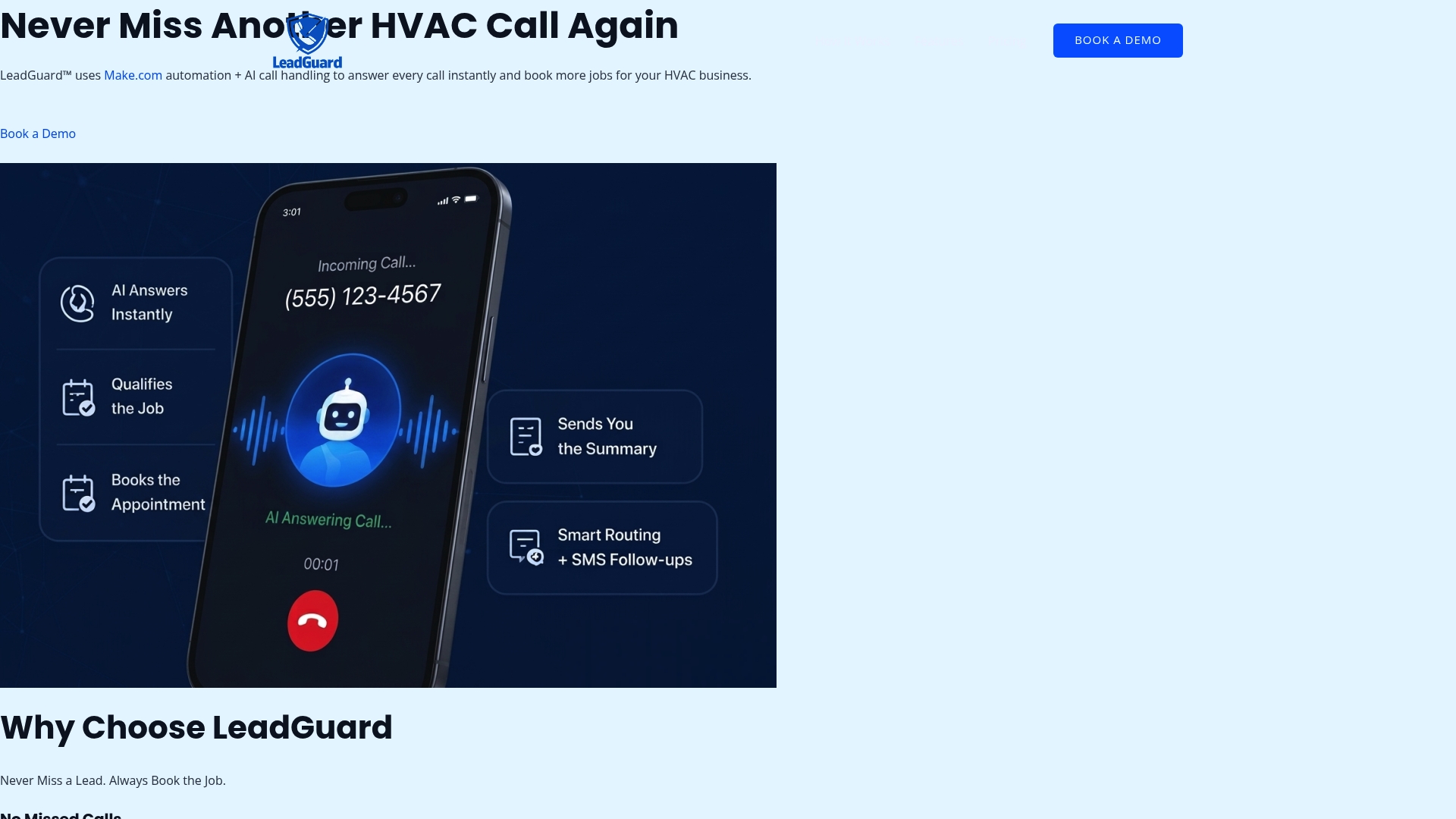
The Starter HVAC Plan suits a small crew that mainly needs instant call answering and basic qualification, no missed calls, no voicemail, no fuss. The Professional Growth HVAC Plan fits a growing business that needs deeper lead qualification and appointment scheduling layered on top of instant answer. The Enterprise HVAC Plan is built for multi-location contractors who need centralized call management across several teams at once, with the routing logic and overflow handling to match.
Whichever tier fits your call volume today, the fastest way to see it in action is to book a demo and watch it handle a live call against your current setup.
Frequently Asked Questions About Round Robin Call Routing
What is round robin routing in a call center?
It’s a distribution method that cycles inbound calls through a group of agents in a fixed sequence, giving each agent a turn before the rotation repeats.
How long should ring timeout be for round robin?
Most implementations start at 10 to 20 seconds, which balances caller patience against giving the assigned agent a fair chance to answer.
Does round robin work for HVAC dispatch teams?
Yes, for general service calls among technicians with similar skills. Specialized jobs, like heat pump certifications, often need skill-based routing layered on top.
What happens when an agent is unavailable in round robin?
The system skips them and moves to the next available agent, but well-built rotations preserve the skipped agent’s position for their next turn.
Is round robin better than skill-based routing?
Neither is universally better. Round robin wins on fairness and simplicity; skill-based or intelligent routing wins on first-call resolution when expertise matters.
Sources
- Exotel Docs — Round Robin Routing
- Intelligent call routing — Salesforce
- Setting up round robin call routing — JustCall Help Center